
Beginner-Friendly Home Workouts You Can Start Doing Today
Getting started with fitness can feel intimidating. Gym memberships, complex machines, and intense classes often make beginners feel out of place. The good news? You don’t need a gym to get fit. Home workouts offer a flexible, cost-effective, and low-pressure way to build strength, burn calories, and improve overall health. This guide will walk you through beginner-friendly home workouts, tips for consistency, and ways to stay motivated.
Why Home Workouts Work
Home workouts remove many barriers to fitness. You don’t need to commute, worry about crowded gyms, or invest in expensive equipment. For beginners, the home environment offers a comfortable, private space to learn movements, experiment with routines, and build confidence. Even with limited space, you can perform exercises that target all major muscle groups.
Additionally, home workouts allow you to progress at your own pace. You can start with simple exercises and gradually increase intensity as your strength and stamina improve. This method reduces the risk of injury and prevents the feeling of being overwhelmed, which is common when jumping straight into advanced routines.
Essential Equipment for Beginners
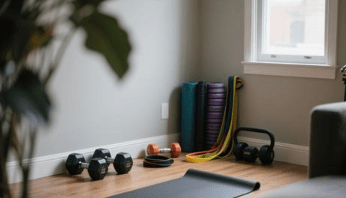
One of the best things about beginner home workouts is that they often require little to no equipment. However, a few items can enhance your routines:
- Yoga mat: Provides cushioning for floor exercises.
- Resistance bands: Great for strength training and toning.
- Dumbbells or kettlebells: Optional for added resistance.
- Stability ball: Useful for core exercises.
Even without any equipment, bodyweight exercises alone can provide a full-body workout. The key is consistency and proper form.
Beginner-Friendly Exercises
Here’s a selection of exercises that are beginner-friendly, require minimal equipment, and target multiple muscle groups. Perform 2–3 sets of 10–15 repetitions for each, adjusting as needed.
1. Squats
Squats strengthen your legs and glutes. Stand with feet shoulder-width apart, bend your knees, and lower your hips as if sitting in a chair. Keep your chest up and knees behind your toes. Return to standing.
Tip: If balance is tricky, hold onto a chair or countertop for support.
2. Push-Ups
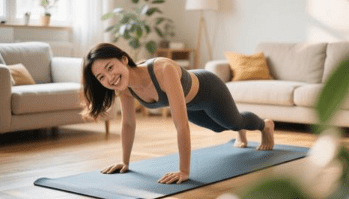
Push-ups target the chest, shoulders, and triceps. Start in a plank position with hands under shoulders. Lower your body until your chest nearly touches the floor, then push back up.
Modification: Beginners can perform push-ups on their knees or against a wall.
3. Lunges
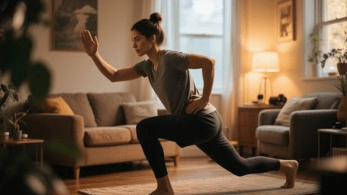
Lunges improve leg strength and balance. Step one foot forward, lower your back knee toward the floor, then push back to standing. Alternate legs.
Tip: Focus on keeping your front knee aligned over your ankle to avoid strain.
4. Glute Bridges
Glute bridges target the lower back, glutes, and hamstrings. Lie on your back with knees bent and feet flat on the floor. Lift your hips toward the ceiling, squeezing your glutes, then lower back down.
Variation: Place a weight or resistance band across your hips for added intensity.
5. Planks
Planks build core strength. Rest on your forearms and toes, keeping your body in a straight line from head to heels. Hold for 20–30 seconds to start, gradually increasing as you get stronger.
Tip: Avoid sagging hips or raised buttocks; form is more important than duration.
6. Step-Ups
Step-ups strengthen legs and glutes. Use a sturdy chair or step, step one foot onto it, and lift your body up, then step down. Alternate legs.
Tip: Ensure the surface is stable to prevent injury.
7. Arm Circles and Shoulder Press
For upper body strength, try arm circles or shoulder presses. Arm circles involve extending arms to the sides and making small circles. Shoulder presses can be done with or without dumbbells, pressing hands overhead and lowering slowly.
Tip: Focus on controlled movements rather than speed.
8. Jumping Jacks or Marching in Place
Cardio is important even at home. Jumping jacks or marching in place gets your heart rate up. Beginners can start slow, focusing on movement rather than speed.
Tip: If joint issues are a concern, step side-to-side instead of jumping.
Structuring a Beginner Home Workout
For beginners, a full-body approach works best. Here’s a simple structure for a 30–40 minute session:
- Warm-Up (5 minutes): Marching in place, arm swings, or gentle stretching.
- Strength Circuit (20–25 minutes):
- Squats: 2 sets × 12 reps
- Push-ups: 2 sets × 10 reps
- Lunges: 2 sets × 12 reps (each leg)
- Glute bridges: 2 sets × 15 reps
- Plank: 2 sets × 20–30 seconds
- Cardio Burst (5 minutes): Jumping jacks or marching in place.
- Cool Down (5 minutes): Stretching major muscle groups and deep breathing.
Start with 2–3 workouts per week and gradually increase to 4–5 sessions as your fitness improves.
Staying Motivated
Consistency is the biggest challenge for beginners. Here are tips to stay on track:
- Set realistic goals: Start with small milestones, like completing three workouts per week.
- Track progress: Keep a simple journal of exercises and reps. Seeing improvements boosts motivation.
- Make it fun: Play music or follow online videos for variety.
- Create a routine: Work out at the same time each day to form a habit.
- Focus on feeling good: Notice increased energy, improved mood, and better sleep, not just weight loss.
Common Beginner Mistakes
Even at home, beginners can make errors that hinder progress or cause injury:
- Skipping warm-ups or cool-downs: Muscles need preparation and recovery.
- Rushing exercises: Proper form is more important than speed or reps.
- Ignoring rest days: Muscles need time to recover and grow.
- Overcomplicating routines: Start simple, then gradually add complexity or resistance.
- Comparing yourself to others: Everyone progresses at their own pace; focus on personal improvement.
Benefits Beyond Fitness
Home workouts offer more than physical benefits. They improve mental health by reducing stress and boosting mood. Regular exercise promotes better sleep and cognitive function. Establishing a consistent routine builds discipline and confidence. And the convenience of exercising at home removes excuses, making it easier to stick with healthy habits.
Gradually Increasing Intensity
As you get comfortable, you can increase intensity without leaving home:
- Add repetitions or sets.
- Hold weights during squats or lunges.
- Extend plank duration.
- Increase cardio bursts or add short intervals of high intensity.
Progression keeps workouts challenging and ensures continuous improvement.
Final Thoughts
Starting a fitness journey at home is both practical and empowering. Beginner-friendly home workouts help you build strength, improve endurance, and develop a consistent habit without feeling overwhelmed. By focusing on proper form, gradual progression, and consistent practice, anyone can experience the benefits of exercise right from the comfort of home.
Remember, the most important step is the first one. Pick a simple routine, set aside time, and start moving. Over time, small, consistent efforts lead to big results—stronger body, sharper mind, and greater confidence.